Pages

About

32-Core CPUs From Intel and AMD

Saturday, December 29, 2012

8-core Intel and AMD CPUs are about to make their way onto desktop PCs everywhere. Next stop: 16 cores.

If your CPU has only a single core, it's officially a dinosaur. In fact,quad-core computing is now commonplace; you can even get laptop computers with four cores today. But we're really just at the beginning of the core wars: Leadership in the CPU market will soon be decided by who has the most cores, not who has the fastest clock speed.

What is it? 
With the gigahertz race largely abandoned, both AMDand Intel are trying to pack more cores onto a die in order to continue to improve processing power and aid with multitasking operations. Miniaturizing chips further will be key to fitting these cores and other components into a limited space. Intel will roll out 32-nanometer processors (down from today's 45nm chips) in 2009.

When is it coming? 
Intel has been very good about sticking to its road map. A six-core CPU based on the Itanium design should be out imminently, when Intel then shifts focus to a brand-new architecture called Nehalem, to be marketed as Core i7. Core i7 will feature up to eight cores, with eight-core systems available in 2009 or 2010. (And an eight-core AMD project called Montreal is reportedly on tap for 2009.)
After that, the timeline gets fuzzy. Intel reportedly canceled a 32-core project called Keifer, slated for 2010, possibly because of its complexity (the company won't confirm this, though). That many cores requires a new way of dealing with memory; apparently you can't have 32 brains pulling out of one central pool of RAM. But we still expect cores to proliferate when the kinks are ironed out: 16 cores by 2011 or 2012 is plausible (when transistors are predicted to drop again in size to 22nm), with 32 cores by 2013 or 2014 easily within reach. Intel says "hundreds" of cores may come even farther down the line.

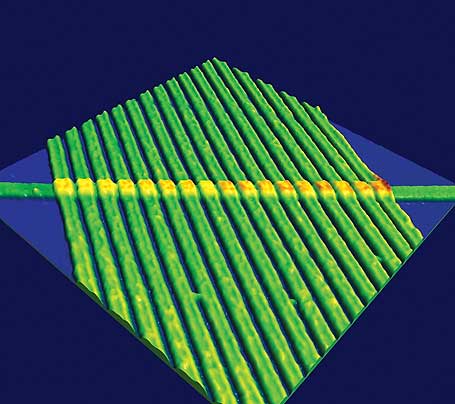
Memristor: A Groundbreaking New Circuit


Since the dawn of electronics, we've had only three types of circuit components--resistors, inductors, and capacitors. But in 1971, UC Berkeley researcher Leon Chua theorized the possibility of a fourth type of component, one that would be able to measure the flow of electric current: the memristor. Now, just 37 years later, Hewlett-Packard has built one.
What is it? As its name implies, the memristor can "remember" how much current has passed through it. And by alternating the amount of current that passes through it, a memristor can also become a one-element circuit component with unique properties. Most notably, it can save its electronic state even when the current is turned off, making it a great candidate to replace today's flash memory.
Memristors will theoretically be cheaper and far faster than flash memory, and allow far greater memory densities. They could also replace RAM chips as we know them, so that, after you turn off your computer, it will remember exactly what it was doing when you turn it back on, and return to work instantly. This lowering of cost and consolidating of components may lead to affordable, solid-state computers that fit in your pocket and run many times faster than today's PCs.
Someday the memristor could spawn a whole new type of computer, thanks to its ability to remember a range of electrical states rather than the simplistic "on" and "off" states that today's digital processors recognize. By working with a dynamic range of data states in an analog mode, memristor-based computers could be capable of far more complex tasks than just shuttling ones and zeroes around.
When is it coming? Researchers say that no real barrier prevents implementing the memristor in circuitry immediately. But it's up to the business side to push products through to commercial reality. Memristors made to replace flash memory (at a lower cost and lower power consumption) will likely appear first; HP's goal is to offer them by 2012. Beyond that, memristors will likely replace both DRAM and hard disks in the 2014-to-2016 time frame. As for memristor-based analog computers, that step may take 20-plus years.

Fingertip tingle enhances a surgeon's sense of touch


OUR fingers are precision instruments, but there are plenty of things they are not sensitive enough to detect. Now we can augment their talents – using wearable electronic fingertips that provide tingling feedback about whatever we touch.
John Rogers of the University of Illinois at Urbana-Champaign and colleagues have designed a flexible circuit that can be worn over the fingertips. It contains layers of gold electrodes just a few hundred nanometres thick, sandwiched between layers of polyimide plastic to form a "nanomembrane". This is mounted on a finger-shaped tube of silicone rubber, allowing one side of the circuit to be in direct contact with the fingertips. On the other side, sensors can be added to measure pressure, temperature or electrical properties such as resistance.
People wearing the device receive electrotactile stimulation – a tingling sensation caused by a small voltage applied to the skin. The size of the voltage is controlled by the sensor and varies depending on the properties of the object being touched.
Surgical gloves are one potential application. Rogers, who worked with colleagues at Northwestern University in Evanston, Illinois, and Dalian University of Technology in China, says gloves fitted with the nanomembrane could sense the thickness or composition of tissue via its electrical properties. A surgeon could also whittle away at the tissue using a high-frequency alternating current supplied by a battery attached at the wrist and delivered via the nanomembrane itself, says Rogers.
Fiorenzo Omenetto at Tufts University in Medford, Massachusetts, is impressed. "The work sets the stage for a new generation of devices," he says.
There are applications beyond surgery, too. MC10, the company commercialising the technology, is running animal trials of a nanomembrane "sock" that can be wrapped around the heart. This provides a 3D map of its electrical activity, useful in treating irregular heartbeat.
MC10 is also working with medical device company Medronic to use the membrane inside the heart, sending it in on a limp balloon, which is then inflated to push the membrane onto the heart's interior walls.
Rogers says MC10 is also collaborating with sportswear firm Reebok on a product to be launched by the end of this year. The aim is to build a "body-worn piece of electronics" designed for contact sports, although Rogers declined to say exactly how it will be used.

Laser cookery makes your food more fun


YOUR toast pops up with a strange pattern burned into it. Pointing your phone's camera at the pattern pulls up a website showing the day's traffic news for your commute. Later, as you're wondering how to make a spring roll, you notice the instructions are etched into the rice paper itself.
These are just a couple of the applications of "laser cookery" envisaged by Kentaro Fukuchi and colleagues at Meiji University in Japan. They reckon laser cutters have done their time in industry and, like 3D printers before them, it's now time for them to come into our homes - as a new breed of laser-enabled kitchen appliances.
At a cookery technology workshop in Nara, Japan, in November, the researchers showed how a bench-top industrial laser cutter - normally used to cut or engrave patterns in plastic, wood and metal - could generate a variety of fascinating foodstuffs when hooked up to a computer running graphics software and a webcam.
One delicacy they have developed is the charmingly named "melt-fat raw bacon", an allegedly tasty sliver of uncooked bacon on which the fat is cooked by the laser, using a webcam trained on the bacon to guide the beam. "The well-cooked fat and the fresh taste of the meat can then be experienced at the same time," says Fukuchi. Don't all rush at once.

Blind juggling robot keeps a ball in the air for hours


It's only a matter of time before robots start running away to join the circus. This "blind" robot - it has no visual sensors - can juggle a ball flawlessly and never gets tired. Designed by Philipp Reist and Raffaello D'Andrea of the Swiss Federal Institute of Technology Zürich, the juggler uses only mathematics to detect the ball's trajectory.
The researchers calculated nine different aspects of a ball's bounce, such as its speed, angle, and spin, and how these parameters change over time as it continues bouncing. The robot itself never knows whether it's actually juggling or not. But to compensate for these changes in the way a ball should bounce, the paddle either speeds up or slows down as it moves to meet the ball, thus keeping it bouncing in a stable arc. To prevent the ball from flying off in any direction, the paddle is slightly curved.
The researchers tried out several different balls such as industrial ball bearings and tennis balls. Nylon balls worked the best, with the robot juggling them as high as 2 metres into the air.
But circus performers and buskers might not need to worry about their jobs after all. The researchers also discovered that the robot is very bad at juggling shoes and Coke bottles - both simple tasks for a human. Well, one who can juggle, anyway.
 

Followers

Most Reading